
1Ahead of the Threat
The Architectural Advantage of Non-Fungible Keys (NFKs)
Layered Authorization, Transactional Control, and Quantum Resilience
By Ron Carter, Founder and CEO, 1AHEAD Technologies · November 2026
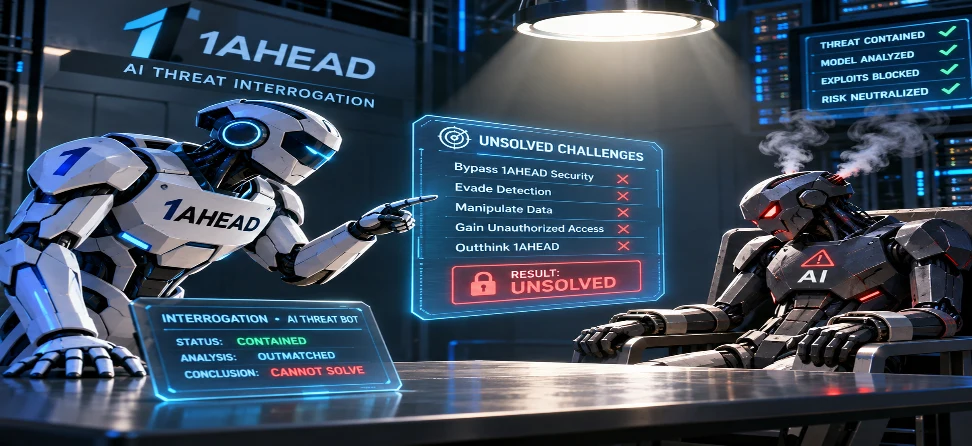
The architectural advantage of Non-Fungible Keys (NFKs) extends beyond adding security checkpoints. It establishes a framework in which access and continued authorization are governed by multiple, independently verified conditions. Unlike conventional credentials that may grant broad or persistent access once authenticated, NFKs associate authority with specific access points, destinations, purposes, and time constraints.
At the foundation of this architecture are personally selected images that function as unique, privately established credentials. Integrated with computer vision, AI, and secure verification services, these images can support unpredictable, transaction-specific authorization challenges. The correct responses may be known exclusively to the transaction originator, while the system verifies their validity without unnecessarily exposing the underlying secret. Properly implemented, these challenges can incorporate protected reference data, cryptographic commitments, and privacy-preserving verification mechanisms, making unauthorized responses difficult to anticipate, derive, or reproduce.
This architecture is especially important when deployed at consequential decision points, including releasing financial payments, transferring confidential records, modifying data-center configurations, entering secure facilities, or directing autonomous machines. The transaction originator or service operator can set different assurance levels, determining the number, placement, and rigor of verification events based on the transaction’s sensitivity and the potential consequences of unauthorized action.
NFKs can also work alongside conventional encryption as a higher-assurance security service. Encryption protects information through established cryptographic mechanisms, while NFK-based authorization independently governs the conditions under which protected information, systems, or physical resources may be accessed and acted upon. The combined architecture can therefore extend protection beyond confidentiality and initial authentication to continuously enforce transaction-specific authority. This capability offers a potential premium security tier for financial institutions, data centers, critical infrastructure, enterprise systems, and other high-consequence environments.
The quantum-resilient significance of NFKs is similarly cumulative. Their protective value does not depend solely on an image’s secrecy or the computational difficulty of breaking a cryptographic algorithm. Instead, the architecture combines privately selected credentials, destination-bound permissions, time-limited validity, unpredictable challenges, and narrowly defined authority. Each independently enforced condition can reduce the operational value of a compromised credential or session and restrict an attacker’s ability to progress through a protected transaction.
Although image-based credentials alone should not be characterized as quantum-proof without independent cryptographic and security analysis, combining layered, context-dependent authorization with established quantum-resistant cryptographic protections offers a credible architectural approach to reducing the consequences of credential compromise. Its resilience derives from requiring an unauthorized party to satisfy multiple conditions governing a transaction, rather than relying exclusively on possession of a credential.
1AHEAD TECHNOLOGIES | FROM REACTIVE DEFENSE TO ARCHITECTURAL PREEMPTION
1AHEAD Technologies approaches today’s escalating cyber, physical, and AI-enabled threats from a fundamentally different direction. Rather than making faster detection and response the principal measure of protection, 1AHEAD proposes an authorization infrastructure that actively confronts attempts to exercise authority. Its NFK architecture can place private, unpredictable, destination-specific challenges at consequential points of action, requiring each request to establish its legitimacy before the system permits it to proceed. The challenge is not an invitation to attack; it is a condition of action that an unauthorized party must satisfy.
The potential significance is an infrastructure in which encryption protects information, authentication establishes identity, and NFK-based controls govern the continuing right to act. Even where an initial credential or session is compromised, properly implemented, independently enforced conditions can interrupt unauthorized progression before a payment is released, data is transferred, a facility is opened, or a machine is directed.
1AHEAD’s defining proposition is therefore not that every threat can be anticipated or every intrusion prevented. It is that access can be separated from authority, and authority can be challenged when it matters. The future of security may be determined less by how quickly systems respond to an attack than by what it never authorizes an attacker to do.
About the Author
Ron Carter is the Founder and CEO of 1AHEAD Technologies, inventor of the wireless video doorbell, and a member of the Forbes Technology Council. His pioneering innovation helped establish a global consumer-security industry. Today, he leads the development of next-generation security technologies supported by 20 issued U.S. patents.